

Your Limiting Beliefs Made Sense Once. They Don't Anymore.

Your brain built your limiting beliefs on purpose, That makes a lot of people uncomfortable because it's easier to treat them like some random malfunction than to accept that your brain was actually trying to protect you.
At some point, probably when you were younger and had way less control over your life, your brain collected information about what was safe, what was possible, and what happened when you tried certain things. It stored those conclusions and started applying them automatically going forward. Your brain sees those beliefs as part of what kept you safe, and you're still here and breathing, so they must be accurate. But they're not. It really does think it's being efficient, but the issue is that efficient isn't the same as accurate.
What's Actually Happening When a Limiting Belief Runs
Your prefrontal cortex handles reasoning, decision-making, and evaluating whether something is actually a threat. Your amygdala handles threat response and emotional memory. When a situation triggers a belief that got encoded during a stressful or painful experience, your amygdala fires before your prefrontal cortex gets a word in.
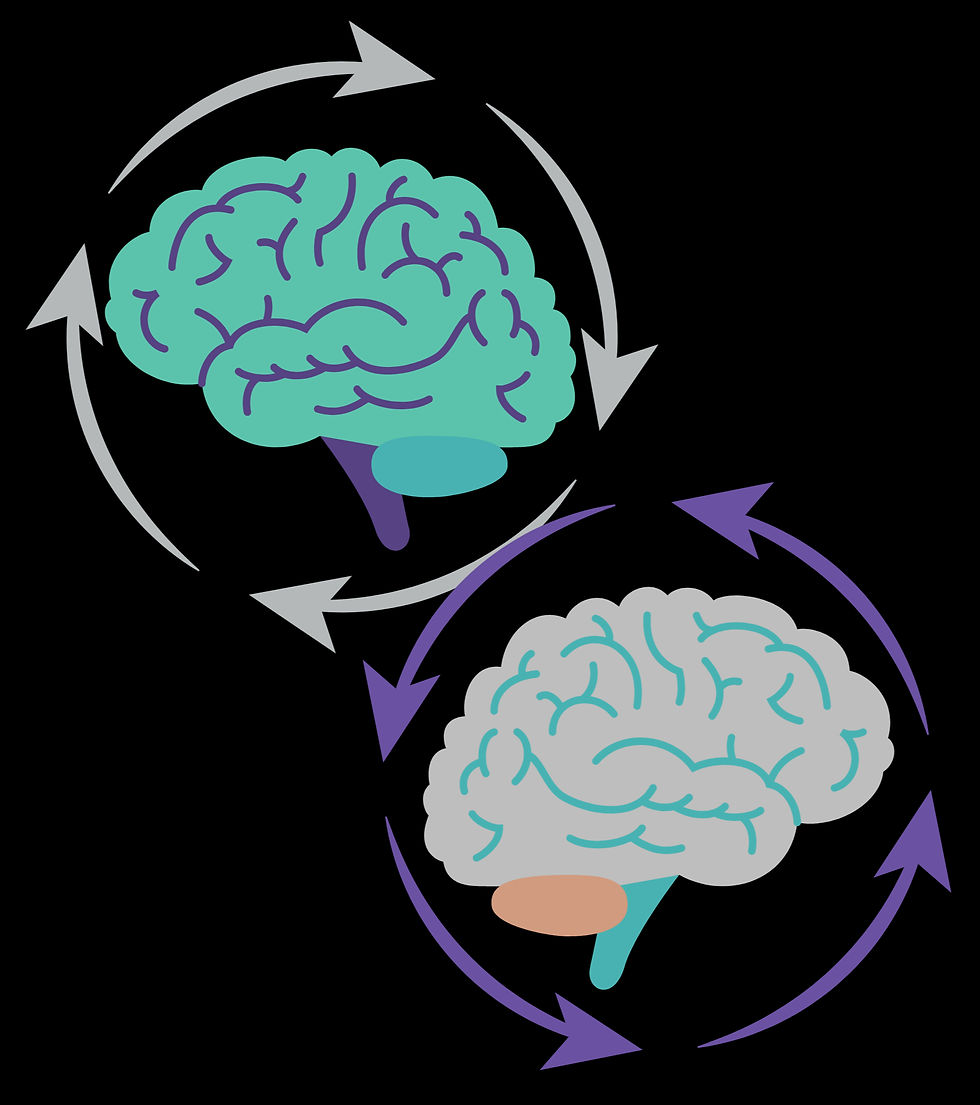
Actually, if you want to know the truth, a process called neuroception takes place before you have ANY awareness that something poses a threat. And do you know what then tells your brain to react? Your body. Your body feels it before your mind even realizes it in most cases. So your brain is reacting to your body - not what's happening in front of you. Crazy, right? But cool! Here's (roughly) what that process looks like 👇

A "negative" trigger is usually linked to something that hurt you at some point earlier in life. So you're reacting to a conclusion or perception from years ago, before you had the skills, the context, the life experience, or the information you have now. And you're treating that reaction as current, accurate data, but it isn't. It's a pattern your nervous system got very good at running because it ran it a lot. And every time it did, it kept you alive, so it reaffirmed for it that it was true.

But interrupting them before they play out, or in the very least recognizing them for what they are (cough, cough, BS) can help to give you a better grasp on responding (instead of reacting) and making more factually based (not emotion-based) decisions.
Start Identifying Them BEFORE They Play Out
Limiting beliefs don't feel like beliefs. They feel like facts.
Like "I'm gonna die on this hill" kinda fact. That's what makes them really hard to catch. You'll know you're dealing with one when your reasoning for not doing something sounds airtight but falls apart the second you actually examine it.
Things like:
"I'm just not good at that kind of thing." Yeah? Based on what, exactly? One
experience from 2012?
"That's not realistic for someone like me." Someone like you, how? Why isn't it realistic? What's that even mean?
"I'd just fail anyway." And that's based on what evidence? How can you prove it?
The story beliefs are always convincing, and that's the whole point. A belief that felt obviously wrong wouldn't have stuck around this long.
What Actually Changes Them

Positive affirmations are not the answer (for like 99.999% of people). Telling yourself "I am capable and worthy" fourteen times in the mirror while you don't actually believe it doesn't rewire anything. It's just noise your brain ignores because it has stronger, older evidence pointing the other direction.
What works is accumulating actual counter-evidence. Small, real, documented proof that the belief is wrong. That means doing the thing you've been avoiding, in a smaller and lower-stakes version, and noticing what actually happens versus what you predicted would happen. Your brain updates based on a combination of repetition, experience, and emotion, not on affirmations. Give it different experiences consistently that make you feel good, and it'll eventually start drawing different conclusions.
Journaling helps here, but only if you're using it as a fact-checking tool rather than a venting outlet. Write down the belief. Write down the actual evidence that supports it. Write down the evidence that contradicts it. Most people find the list of contradicting evidence is longer than they expected, because their brain has been selectively ignoring it for years.
The Part That Takes the Longest
Knowing a belief is inaccurate doesn't make it stop. That's probably the most frustrating thing about this work because you're "fighting" a brain that values familiarity over everything. So if what you're trying to do is something it sees as unfamiliar, it's gonna suck you back into the suck pretty quick. Because it's the "suck" that is familiar. However, that's where you can use its need for repetition against it (and in your favor). You can intellectually understand that your belief is outdated and still feel it kick in every time you're in a situation that triggers it. But noticing it is the first step in maintaining a consistent routine for challenging it.
It's totally normal to feel the belief sneak in, by the way. Neural patterns that got reinforced over years don't dissolve after one good journaling session. They fade through consistent interruption. You catch the belief, you fact-check it, you do the thing anyway, you write down your wins no matter the size, and you do that enough times that your brain starts building a different pattern alongside the old one.
Where to Start
✔️ Pick one belief. (JUST ONE. You can work on the rest later)
✔️ Write it down the way you'd really say it to yourself (not the therapized version)
✔️ Then ask: what would I do differently if that belief turned out to be wrong?
✔️ Give an HONEST answer.
✔️ When you notice it creeping in, fact-check or challenge it.
Start there. If you want something more structured to learn how to spot patterns (and to de-stress), the Oh Shit Tool Kit is free, and it's built for exactly this kind of pattern interruption. Grab it when you join the ShiftList!

Comments